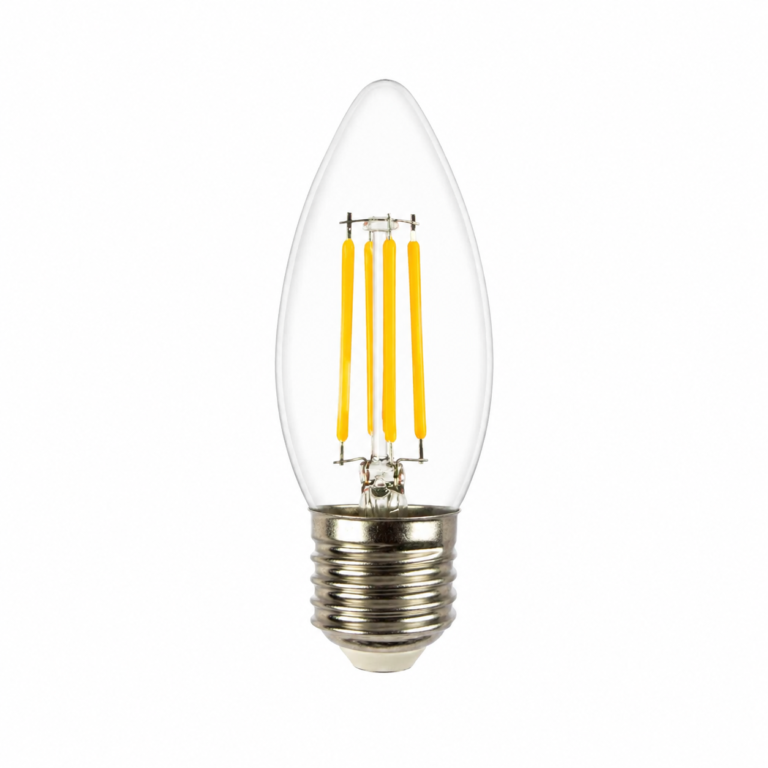
LED Filament Bulbs for Bedroom Ceiling Fixtures
Check bulb dimensions, enclosed-fixture suitability, light output and controls when choosing LED filament bulbs for bedroom ceiling fixtures.

Choose an LED filament bulb for a bedroom ceiling fixture by checking physical fit, rated supply, permitted fixture conditions, light output and controls. Approve the selected bulb in the actual fixture before a bulk purchase for a hotel, apartment or residential project.
Check the Ceiling Fixture Before the Bulb Style
Collect the fixture model or drawing and identify the lamp holder. Measure the available space around it, including the cover or shade opening and any decorative parts. Confirm access for fitting and replacing the bulb after the fixture is assembled.
The A60, ST64 and C35 dimension comparison shows why bulb shape alone is insufficient. Its selected A60 and ST64 examples use E27, while the C35J example uses E14. Use the exact model drawing and supply rating for your installation.
Bedroom Ceiling Bulb Selection Checklist
| Check | What to confirm |
|---|---|
| Physical fit | Exact base, bulb dimensions, shade opening, cover clearance and replacement access. |
| Fixture conditions | Whether the fixture is enclosed and the bulb approval needed for its operating conditions. |
| Light requirement | Desired room appearance, useful illumination and any separate reading or task lights. |
| Controls | On/off or dimming, controller details and the approved bulb-and-control combination. |
Confirm Enclosed-Fixture Suitability Explicitly
A ceiling cover or shade can affect the conditions around the lamp. Ask the fixture supplier about the intended bulb type and operating requirements, then confirm that the proposed bulb is approved for those conditions. Low wattage, LED construction or a decorative application image does not establish enclosed-fixture suitability.
Include the fixture reference and installation conditions in the sample request. Keep any limitations in the purchasing record so a replacement model can be reviewed against the same requirements.
Specify Light Output and Appearance Separately
Decide what the ceiling fixture needs to illuminate and whether reading, desk work or wardrobe areas have separate lighting. Request model-specific lumen output and assess the assembled fixture in the intended room. A fixed wattage range cannot establish the required illumination for every bedroom layout.
Specify color temperature and glass finish separately. Review the sample with the room’s finishes and from the normal viewing positions, including from the bed where the bulb or shade may be directly visible. Record the accepted appearance and any glare observations.
For example, the A60 E27 6W clear model publishes 650 lm, 2700 K, AC220–240 V and non-dimmable operation. These values identify one model; they do not establish its suitability for every ceiling fixture or the lighting needs of every room.
Approve the Controls with the Bulb
If the project uses dimming, select a model explicitly specified as dimmable. Record the control method, dimmer model, supply and lamp count, then test the proposed combination. Include starting behavior, required adjustment range, visible instability and noise in the review.
Use the dimming sample test checklist to document the combination. App control, wireless operation and a particular smart-home protocol require separate confirmation for the selected product.
Keep a Repeatable Room Sample Record
For multiple rooms, approve a representative fixture-and-bulb combination and record its model references, drawings, light settings and sample date. Identify any room or fixture variation needing a different bulb. Confirm the order quantities, spare-lamp requirements, packaging and destination documents in the quotation.
Compare LED filament bulb models or send TITK the ceiling fixture details for a model-specific review.