
How Lighting Distributors Should Specify LED Bulbs for Wholesale Supply
A practical guide for distributors on how to specify LED bulbs for wholesale supply, avoid mismatches, and confirm the right model before ordering.

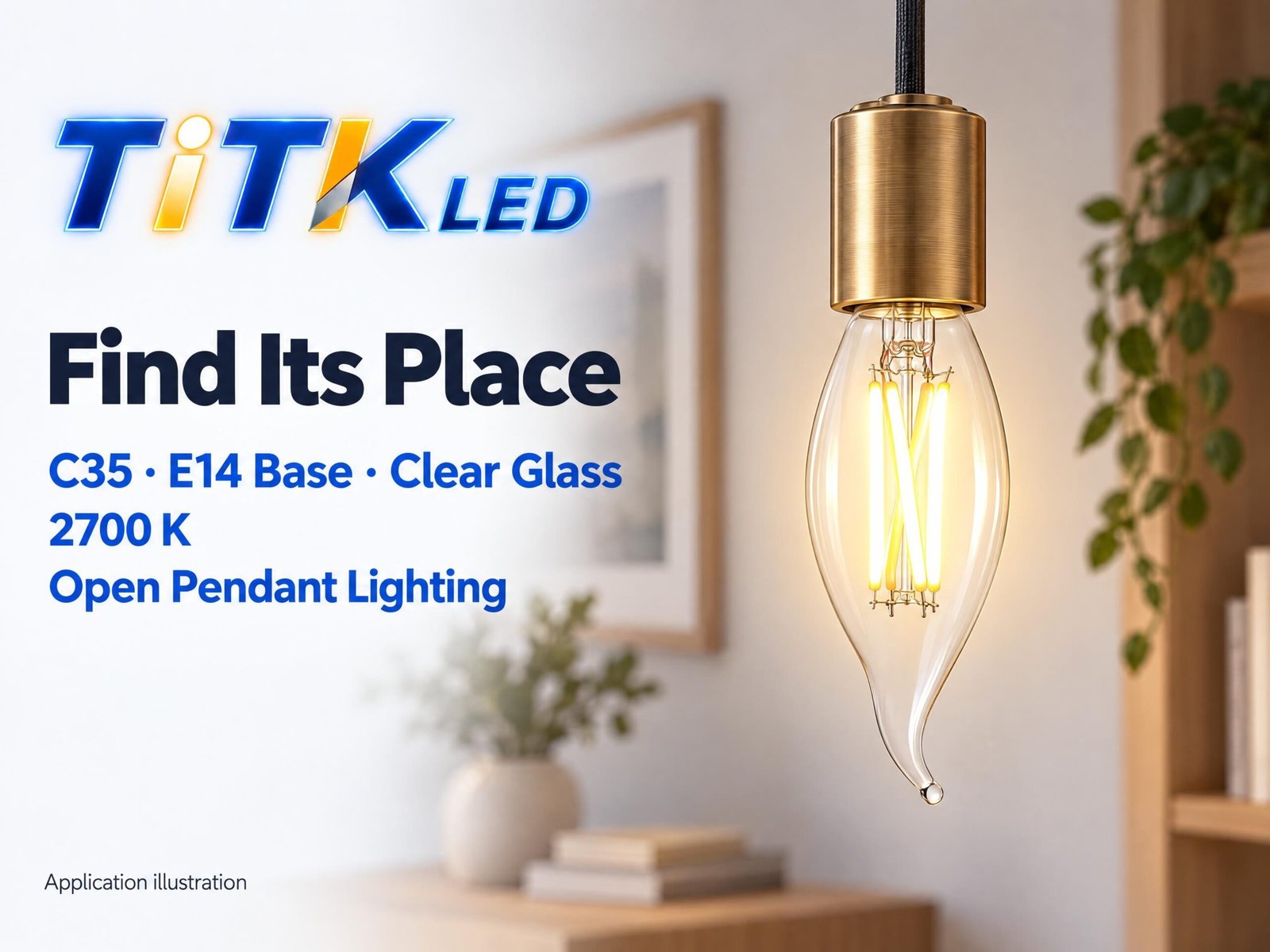
When buyers search for LED bulbs for lighting distributors, the real question is usually not “which bulb looks best?” It is “how do I specify the right bulb so the order matches the fixture, market, and customer expectation?” For wholesale projects, that difference matters. A bulb that looks suitable in a catalog can still fail a project if the base, voltage, glass finish, or color temperature does not match the application.
For distributors, installers, importers, and informed consumers, the safest approach is to treat LED bulb selection as a specification exercise. The goal is to confirm the details that affect fit, appearance, and electrical compatibility before you place an order. That is especially important for decorative products, where shape and visual effect are part of the buying decision.
What distributors should confirm before ordering
In wholesale sourcing, the same product family can appear in many configurations. TITK focuses on LED filament bulbs and decorative LED bulbs, including candle, globe, Edison-style, and tubular designs. These product families are commonly used in hotels, restaurants, cafes, bars, retail stores, villas, commercial interiors, and decorative fixtures.
Before approving any model, confirm these core points:
- Lamp base: Depending on the model and project requirements, TITK products may use E14, E26, E27, or B22 bases.
- Voltage: Voltage must always be confirmed for the individual model. Available configurations may include AC 110–120 V, AC 220–240V, or DC low-voltage designs.
- Glass finish: Options may include clear glass, amber tea glass, smoke grey glass, frosted glass, or milky glass, depending on the model.
- Color temperature: Depending on the model, options may include 2200K, 2700K, 3000K, 4000K–4500K, or 6500K.
- Function: Some models are dimmable, some support smart control, and some offer dual-CCT or low-voltage operation.
This is where many procurement problems start. A distributor may assume the same shape means the same electrical spec, but that is not safe. Verify the exact model rather than relying on appearance alone.
Why shape is only part of the decision
Shape is important, but shape does not define performance or compatibility. For example, a globe bulb, a candle bulb, and an Edison-style bulb can all create very different visual effects even before you consider base type, wattage, or finish. The same is true when comparing clear glass bulbs with frosted or smoke glass versions.
For lighting distributors, the practical question is not just whether the bulb looks vintage or decorative. It is whether the bulb delivers the right light for the fixture and the market. A pendant in a restaurant, a chandelier in a villa, and a wall sconce in a hotel corridor can all require different combinations of base, size, output, and color temperature.
If you are building a wholesale assortment, it helps to organize by use case first and style second. That approach makes it easier to avoid mixed specifications that confuse customers or installers.
How to compare commercial LED bulb options
Distributors often need a simple way to compare LED bulb options across multiple projects. The table below shows the main specification areas to review before placing a wholesale order.
| Specification area | What to confirm | Why it matters |
|---|---|---|
| Base type | E14, E26, E27, or B22, depending on the model | Ensures physical fit in the fixture |
| Voltage | AC mains or low-voltage design, confirmed per model | Prevents wiring and power mismatches |
| Glass finish | Clear, amber tea, smoke grey, frosted, or milky | Changes visual appearance and light effect |
| Color temperature | Warm, neutral, or cool white options depending on model | Shapes ambience and customer preference |
| Function | Dimmable, smart, or dual-CCT if required | Supports control and project requirements |
For decorative LED bulbs, this comparison is especially useful because buyers often choose by appearance first. A clear specification sheet keeps the conversation focused on compatibility and application rather than subjective impressions.
Practical examples of model-specific thinking
TITK offers several verified product configurations that show why model-specific review matters.
ST58 / ST19 LED filament bulb
The verified ST58 / ST19 configuration is a 6W vintage / Edison-style LED filament bulb with an E26 base, AC 110–120 V input, 2700K warm white light, 800 lm, CRI 90+, clear glass, and dimmable function. This is a useful example of a decorative bulb that combines classic style with a specific electrical and visual profile.
ST64 / ST21 2.4G smart LED filament bulb
The verified ST64 / ST21 2.4G smart LED filament bulb is a 6W model with an E26 base, AC 110–120V / 60Hz input, 650 lm, CRI 90+, and 2.4GHz RF remote control with smooth dimming and adjustable color temperature. It can operate in 2700K, approximately 4000K–4500K, or 6500K modes. This kind of model is useful when the project needs both decorative appearance and controllable lighting.
ST64 low-voltage dual-CCT bulb
The verified ST64 low-voltage dual-CCT LED filament bulb uses an E27 base and low-voltage operation. Available configurations may include DC 3.7V and DC 5V, with warm-white mode around 2700K, cool-white mode around 6500K, and an intermediate natural-white appearance around approximately 4000K–4500K when warm and cool filaments operate together. This is a reminder that low-voltage bulbs should never be assumed to work on mains AC power.
Where distributors add the most value
Wholesale buyers do more than place orders. They help customers avoid specification mistakes. That means checking whether the fixture needs a standard mains-voltage bulb or a low-voltage design, whether the market prefers warm white or cooler white, and whether the application calls for a clear glass decorative effect or a softer finish.
In practice, this makes LED bulb sourcing easier for both the buyer and the end customer. A well-specified order reduces back-and-forth during installation and helps maintain consistency across repeat purchases.
If your business sells to hospitality lighting, commercial interiors, or retail projects, it may be worth standardizing a few proven configurations. You can then expand the assortment by shape, finish, and function while keeping the core electrical requirements stable.
What to ask TITK before you place a wholesale order
When discussing OEM LED bulbs, ODM lighting, or standard wholesale supply, ask for the exact model specification rather than a general product family description. Useful questions include:
- Which base is available for this model?
- What voltage configuration is confirmed for the intended market?
- Which glass finish is available for this design?
- Does the model support dimming, smart control, or dual-CCT?
- Can the product be customized according to the project requirements?
TITK supports OEM and ODM cooperation for B2B customers, and customization may include product specifications, lamp base, input voltage, wattage, color temperature, glass finish, filament design, dimming functions, smart-control functions, branding, private label, and packaging. Final feasibility must always be confirmed for the specific project.
Next steps for wholesale buyers
If you are sourcing wholesale LED bulbs, the best next step is to define the application first, then match the model to the fixture, voltage, and visual requirement. That process is more reliable than choosing by shape alone.
For buyers comparing LED Edison bulbs, LED candle bulbs, LED globe bulbs, or dimmable LED bulbs, confirming the specification early will save time later. If needed, you can also review the broader LED Bulbs category before requesting a quotation.
Contact TITK to confirm voltage, base, finish, and product availability for your project, or request a quotation for the exact configuration you need.



