LED Bulb Sourcing Guide for Buyers, Distributors, and Installers
A practical LED bulb sourcing guide for international buyers: how to compare specs, confirm compatibility, and reduce ordering mistakes.

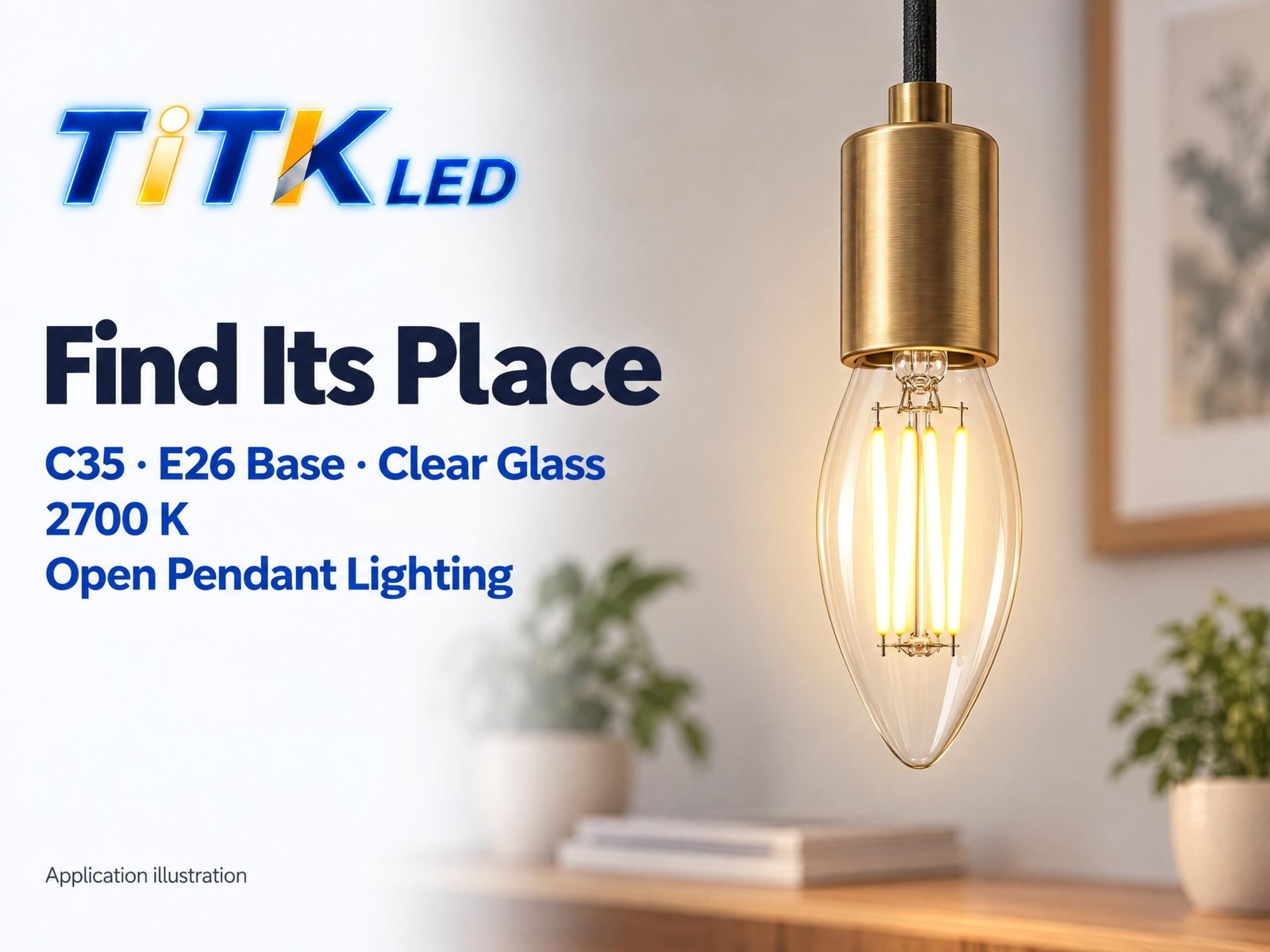
For international buyers, a successful LED bulb order starts long before price comparison. The most effective sourcing process is a specification check: confirm the bulb shape, base type, voltage, color temperature, glass finish, and intended application before you request samples or place volume orders.
This LED bulb sourcing guide is designed for distributors, installers, project buyers, and informed consumers who need a practical way to compare products and avoid specification mistakes. It also applies to wholesale LED bulbs where one incorrect detail can affect fixture fit, dimming behavior, or installation speed.
TITK, a Zhongshan, Guangdong, China manufacturer and B2B supplier, focuses on LED filament bulbs and decorative LED bulbs for wholesale and project supply. Depending on the model, TITK offers options such as E14, E26, E27, and B22 bases; clear, amber tea, smoke grey, frosted, and milky glass; and color temperatures such as 2200K, 2700K, 3000K, 4000K–4500K, and 6500K. Please confirm the final specification for each model before ordering.
1) Start with the fixture, not the bulb
Before comparing suppliers, identify where the bulb will be used. A bulb for a pendant light is not automatically suitable for a chandelier, wall sconce, table lamp, or decorative fixture. The fixture determines clearance, visual style, and sometimes the acceptable base and voltage.
For example, if you are planning lighting applications in hospitality or retail spaces, the bulb may need to balance appearance with comfort and consistency. If the project is decorative, shape and glass finish may matter as much as output. If the project is functional, the priority may be compatibility and serviceability.
- Check the fixture base first.
- Confirm whether the lamp is designed for mains or low-voltage operation.
- Measure space for bulb height and diameter.
- Decide whether the bulb is decorative, task-oriented, or both.
2) Confirm the exact base and voltage
Base type and input voltage are two of the most important sourcing details. TITK products may use E14, E26, E27, or B22 bases depending on the model and project requirements. Voltage also varies by model, with some products designed for AC 110–120 V, some for AC 220–240V, and others for DC low-voltage applications such as DC 3.7V or DC 5V.
This is where many sourcing errors happen. Never assume that a low-voltage bulb can be connected directly to mains AC power. Likewise, do not assume that a mains-voltage bulb is suitable for a low-voltage installation. The safest approach is to verify the rating on the specific product page or quotation and, when needed, consult a qualified installer.
If you are comparing E26 bulbs or E27 bulbs for a project, make sure the socket standard matches the destination market and fixture design. For specialty projects, ask TITK whether the specification can be customized according to the project requirement.
3) Choose the right shape for the visual result
Shape is more than styling. It affects how the bulb looks in a transparent fixture and how much visual presence it has in the room. TITK supplies several core families, including C35 candle LED filament bulbs, G45 globe LED filament bulbs, A60 LED filament bulbs, ST58 Edison LED filament bulbs, ST64 Edison LED filament bulbs, T30 tubular LED bulbs, G80 globe LED bulbs, G95 globe LED bulbs, G125 globe LED bulbs, and other decorative formats.
For Edison bulbs and other visible-lamp applications, shape often defines the first impression. Candle bulbs work well where a slimmer silhouette is needed. Globe bulbs are often chosen when a rounder decorative presence is preferred. Tubular bulbs can suit linear or vintage-inspired designs. For a broad overview, buyers can review TITK’s LED Filament Bulbs category or the LED Edison Bulbs selection when comparing decorative styles.
4) Match color temperature to the project atmosphere
Color temperature should be chosen according to the room, fixture, and desired mood. Depending on the model, TITK LED bulbs may be available in 2200K, 2700K, 3000K, 4000K–4500K, or 6500K. Some models support multiple color temperatures or adjustable CCT.
For warm white lighting, buyers often look at lower color temperatures such as 2200K, 2700K, or 3000K. These are commonly considered for spaces where a softer or more relaxed appearance is preferred. Higher color temperatures may be selected where a brighter, cooler visual effect is wanted. The key is to match the tone to the fixture and the customer expectation, rather than choosing a number in isolation.
If you are sourcing for hospitality or interior décor, decorative lighting decisions often depend on both color and glass finish. Always confirm whether the selected model offers the desired CCT before final approval.
5) Check glass finish as part of the specification
Glass finish can change the look of a bulb even when the base and shape are the same. Depending on the model, TITK products may be available in clear glass, amber tea glass, smoke grey glass, frosted glass, or milky glass. Availability depends on the specific model.
For visible-lamp fixtures, glass finish is often part of the design language. Clear glass highlights the filament appearance. Amber or smoke finishes can create a different decorative effect. Frosted or milky glass may be preferred when a softer visual appearance is needed.
If your project involves clear glass bulbs or darker decorative finishes, confirm that the finish is available for the exact model you want. Do not assume the same finish exists across all TITK products.
6) Understand dimming, smart control, and low-voltage options
Some TITK models are available as dimmable LED filament bulbs, smart LED filament bulbs, dual-CCT LED bulbs, or low-voltage LED filament bulbs. These functions are model-specific and should be confirmed before purchase.
When comparing dimmable LED bulbs, check the bulb specification and the compatibility of the control method used in the project. Dimming behavior can vary by model and installation context. For buyers exploring more decorative options, TITK also provides product categories such as Dimmable LED Bulbs and Decorative LED Bulbs.
If a project uses low-voltage supply, confirm the exact low-voltage design and never connect it to mains power unless the product is specifically rated for that use. For smart-control or dual-CCT needs, request the approved configuration rather than assuming it can be added later.
7) Use a simple sourcing checklist before placing an order
A practical LED bulb buying guide should reduce ambiguity. Before confirming an order, check the following:
- Base: E14, E26, E27, or B22 as required.
- Voltage: AC 110–120 V, AC 220–240V, or a specified DC low-voltage design.
- Shape: candle, globe, tubular, Edison-style, or another decorative format.
- Glass finish: clear, amber tea, smoke grey, frosted, or milky, if available.
- Color temperature: confirm the exact CCT and whether multiple modes are supported.
- Function: dimmable, smart, dual-CCT, or low-voltage as required.
- Application: verify the bulb suits the fixture and intended space.
8) Request samples, then confirm the final specification
For B2B purchasing, samples are useful because they let you verify physical fit, appearance, and perceived light quality before committing to larger volumes. This is especially important for decorative LED bulbs, where the visual result is part of the product value.
If you are sourcing for commercial lighting, ask for the exact product model, base, voltage, finish, and packaging before approval. For OEM and ODM projects, TITK supports cooperation on product specifications, lamp base, input voltage, wattage, color temperature, glass finish, filament design, dimming functions, smart-control functions, branding, private label, and packaging, depending on the project.
When needed, review product families such as LED Candle Bulbs for slim decorative options or LED Bulbs for a broader category overview.
9) Final buying advice for international buyers
The most reliable sourcing process is simple: define the application, confirm the socket and voltage, choose the shape and finish, and then verify the exact model specification with the supplier. That approach reduces installation surprises and makes reordering easier across markets.
For international buyers, distributors, and project teams, TITK can discuss wholesale needs, product specifications, and OEM/ODM options. If you are comparing options now, request a quotation, ask for samples, or confirm the final specification with TITK before placing an order.
Note: electrical installation and compatibility should be reviewed by a qualified professional where appropriate and in line with local requirements.