
LED Bulb Quality Control: What Buyers Should Check Before Ordering
A practical guide to LED bulb quality control for B2B buyers, distributors, and installers, with a focus on specification checks, inspection points, and order approval.

LED Bulb Quality Control: Why It Matters Before Purchase
For commercial projects, retail rollouts, hospitality spaces, and residential developments, LED bulb quality control is not only a factory issue. It is also a sourcing decision. A bulb that looks correct in a catalog can still create problems if the base, voltage, glass finish, dimming behavior, or color temperature does not match the fixture and application.
That is why B2B buyers, installers, and distributors should treat quality control as a specification review process, not just a visual inspection. The goal is to confirm that the selected product can be used consistently across the project and that the supplier can deliver the same model according to the agreed requirements.
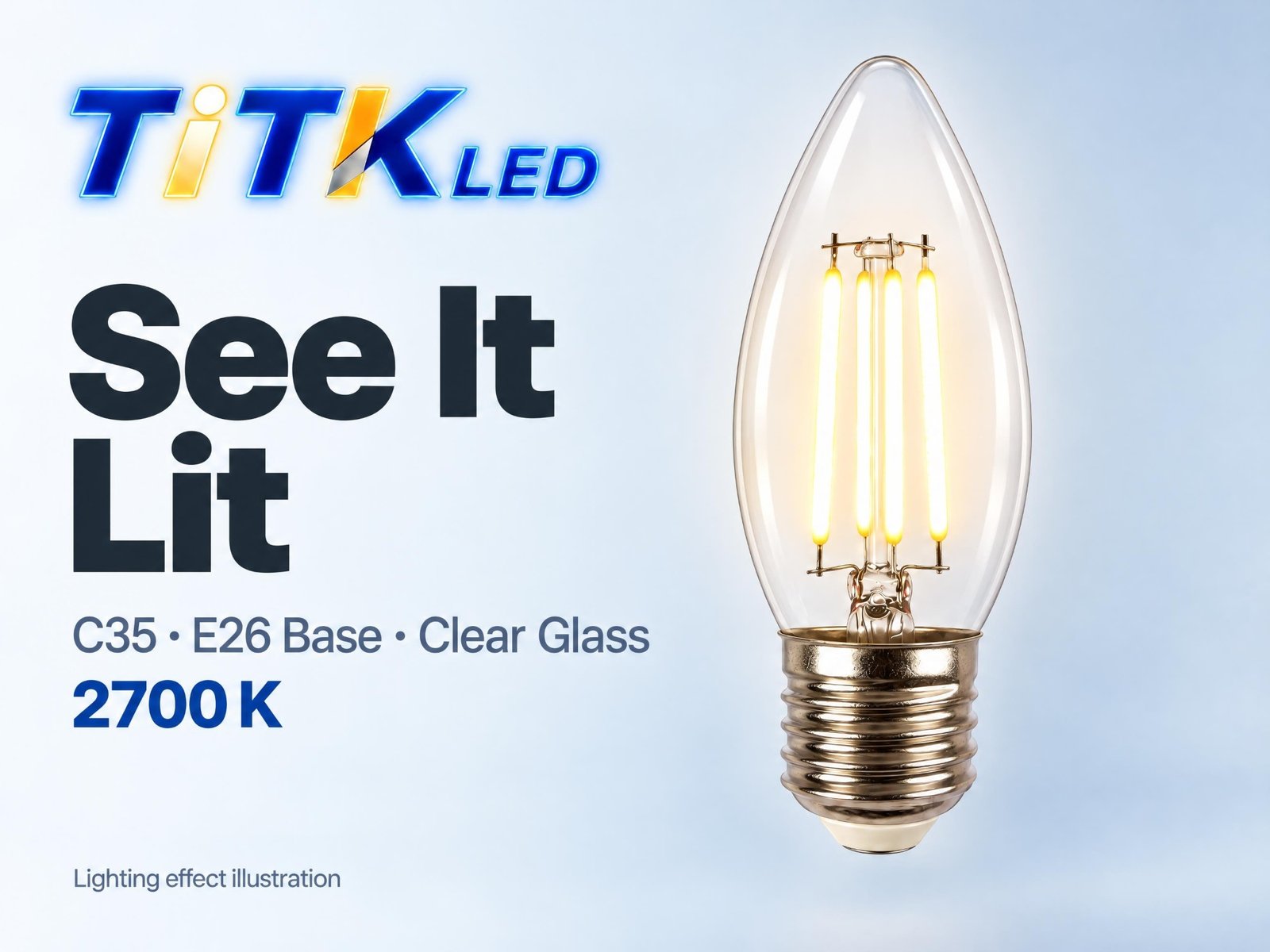
For product families such as LED Filament Bulbs and Decorative LED Bulbs, the details matter: the shape, lamp base, voltage, and finish should all be checked before ordering. TITK supplies LED filament bulbs and decorative LED bulbs for wholesale and project-based cooperation, including OEM and ODM requirements depending on the model.
Start With the Specification Sheet, Not the Product Photo
Product photos can help identify the general style, but they do not confirm the full specification. A proper buying process starts with written data. Before approving a model, confirm the lamp base, input voltage, wattage, color temperature, glass finish, dimming function, and any project-specific customization.
This is especially important in decorative lighting, where a bulb may look suitable but still be the wrong fit for the fixture or electrical standard. If the order is for commercial lighting or hospitality lighting, ask whether the same model is available in the required configuration for each market or site.
When voltage is involved, do not assume compatibility. TITK produces products for different voltage applications depending on the model, including AC 110–120 V, AC 220–240V, and low-voltage designs such as DC 3.7V or DC 5V for selected models. The correct voltage must always be confirmed for the individual product.
Inspect the Core Quality-Control Points
In LED bulb quality control, the most practical checks are the ones that affect installation and end-user experience. These are the points buyers should confirm before mass purchase.
| Quality-control area | What to confirm | Why it matters |
|---|---|---|
| Base type | E14, E26, E27, or B22 depending on the model | Prevents installation mismatch |
| Voltage | AC or low-voltage version as specified | Avoids electrical incompatibility |
| Color temperature | Warm white, neutral white, or cool white as required | Supports the intended atmosphere |
| Glass finish | Clear, amber tea, smoke grey, frosted, or milky glass depending on model | Shapes the visual effect |
| Dimming | Whether the model is dimmable and which dimmer it should work with | Reduces compatibility issues |
| Dimensions | Bulb size and clearance in the fixture | Prevents fitting problems |
These checks are basic, but they solve many real project problems. For example, a decorative bulb may be correct in appearance but unusable if the clearance inside the shade is too tight or the base does not match the fixture.
Color Consistency Is Part of Product Quality
For projects with multiple fixtures, color consistency is often more important than a single bulb’s appearance. Buyers looking for warm atmosphere lighting often compare options such as 2200K, 2700K, and 3000K depending on the model. In some projects, a neutral white or cooler appearance may be better suited to the design.
If the project requires tunable white lighting, confirm whether the chosen product family supports adjustable CCT. TITK offers selected models with multiple color temperature modes or dual-CCT functions, but this is model-specific and should be confirmed before ordering.
When buying decorative LED bulbs for visible fixtures, ask for samples and compare them under the actual installation conditions. This is a useful step in LED bulb testing because ambient materials, fixture shade color, and room finish can change how the light appears in practice.
Dimming Should Be Verified as a System, Not a Feature
Many buyers ask for dimmable LED bulbs, but dimming performance depends on the whole system. The bulb, the dimmer, and the electrical installation must all be compatible. A bulb described as dimmable does not automatically guarantee smooth behavior with every control device.
If dimming is important for the project, request the exact model and confirm the intended control method. For example, TITK offers selected dimmable LED bulbs, and some smart LED bulbs or dual-CCT products include additional control functions depending on the model. The buyer should verify these functions with the final specification before approval.
This is especially relevant in hotels, restaurants, cafes, bars, and residential interiors where lighting levels may need to change throughout the day. In such lighting applications, inconsistent dimming can be more noticeable than in simple on/off installations.
Use Sampling to Check Real-World Fit
Sampling is one of the most effective parts of LED bulb quality control. A sample can reveal whether the bulb fits the socket properly, sits well in the fixture, and gives the intended visual result. It can also help installers check whether the product is practical for the site conditions.
For buyers working with LED bulb manufacturers, the sample stage is also the right time to confirm packaging, labeling, and branding requirements. TITK supports OEM and ODM cooperation for B2B customers, and customization may include product specifications, lamp base, input voltage, wattage, color temperature, glass finish, filament design, dimming functions, smart-control functions, branding, private label, and packaging depending on the project.
For buyers comparing product families, it can help to review the relevant category pages, such as LED Edison Bulbs, LED Candle Bulbs, and Dimmable LED Bulbs.
What B2B Buyers Should Ask Before Order Approval
Before placing a wholesale or project order, use a simple approval checklist:
- Is the bulb base correct for the fixture?
- Is the voltage confirmed for the target market?
- Is the color temperature suitable for the space?
- Is the glass finish aligned with the design intent?
- Is dimming required, and has compatibility been checked?
- Do the dimensions fit the lamp, pendant, chandelier, or wall sconce?
- Has a sample been reviewed under real installation conditions?
These steps are useful for distributors, installers, and informed consumers alike. They reduce avoidable returns and help keep specifications aligned across multiple orders.
How TITK Supports Specification-Based Buying
TITK is a Zhongshan, Guangdong-based LED lighting manufacturer and B2B supplier focused on LED filament bulbs and decorative LED bulbs. Its product families include candle bulbs, globe bulbs, tubular bulbs, and decorative Edison bulbs, with model-dependent options for base type, glass finish, color temperature, and voltage.
For commercial lighting and hospitality lighting projects, the most important buying habit is to confirm the final specification before ordering. That applies whether the project uses clear glass bulbs, amber glass bulbs, smoke glass bulbs, or other finishes. It also applies to low voltage LED bulbs, where the operating voltage must match the intended installation.
If you are sourcing wholesale LED bulbs for a project, request the specification sheet, ask for samples, and confirm the final configuration before approval. For model-level details or OEM/ODM discussion, contact TITK to confirm voltage, base, finish, and customization options.



