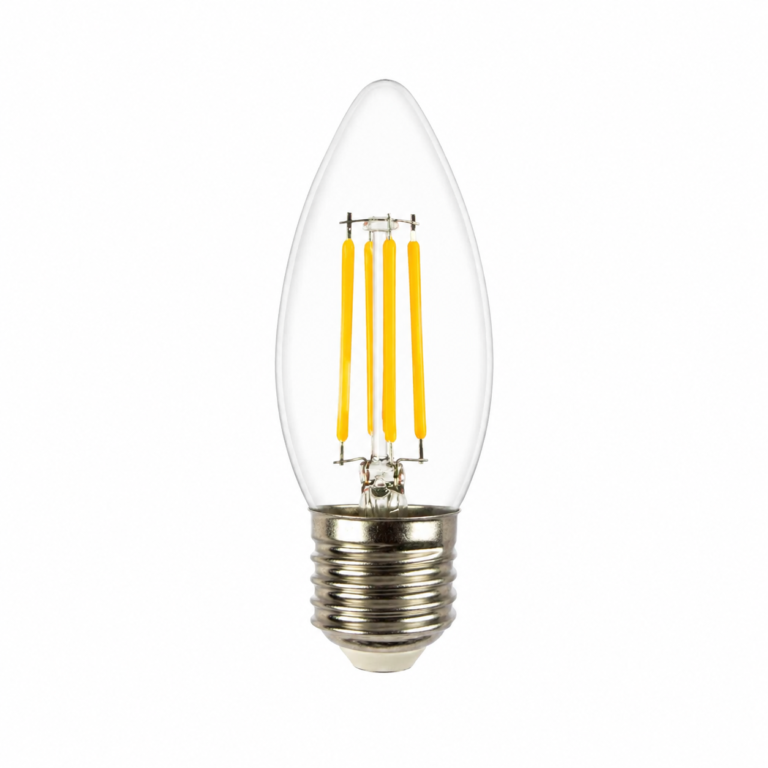
LED Filament Bulb Electricity Cost: A Worked Example
Estimate filament bulb electricity costs using watts, lamp count, operating hours and your energy rate. Follow a worked example with clear assumptions.

To estimate an LED filament bulb’s electricity cost, multiply rated watts by the number of lamps and operating hours, divide by 1,000, then multiply by the electricity rate. Keep light-output requirements separate: a lower-wattage bulb is not necessarily a suitable replacement.
Collect Four Inputs
- Watts per lamp: use the proposed configuration’s rated power, or an agreed measured value for the calculation.
- Lamp quantity: count the lamps on each schedule line.
- Operating hours: estimate the hours for the period being compared.
- Electricity rate: use the relevant energy charge in the project’s currency and billing period.
The U.S. Energy Information Administration explanation of electricity measurement distinguishes power in watts from energy used over time in watt-hours and kilowatt-hours.
Energy and Cost Formula
Energy (kWh) = watts per lamp × lamp quantity × operating hours ÷ 1,000.
Energy cost = energy (kWh) × price per kWh.
Calculate separate lines for zones that have different operating hours or lamp configurations, then add the energy totals.
A Worked Example with Declared Assumptions
| Rated power per lamp | Total energy | Illustrative cost |
|---|---|---|
| 2 W | 400 kWh | USD 60.00 |
| 6 W | 1,200 kWh | USD 180.00 |
The rate, quantity and operating hours above are hypothetical teaching inputs, not a current electricity tariff or a quotation. The two rows show arithmetic for different connected loads; they do not show equivalent illumination, a recommended substitution or a measured saving.
Compare the Required Light Before the Cost
The current A60 E27 2 W clear model lists 150 lm at 2200 K. The A60 E27 6 W clear model lists 650 lm at 2700 K. Both are non-dimmable. Their different output and CCT mean that choosing between them requires a lighting review, even though they share a shape and base.
The ENERGY STAR explanation of brightness describes lumens as light output. This general reference is not a statement that either TITK model is ENERGY STAR certified.
Keep Other Costs Separate
The formula estimates lamp energy use at the stated power. Add any separately supplied equipment where relevant, and use actual operating information if controls change the load. Do not assume dimming percentage equals energy reduction.
Purchase price, replacement labor, service-life assumptions, demand charges and other bill items need their own inputs. The hotel lighting lifecycle-cost guide covers a broader cost review.
Electricity Cost Questions
Can I use one annual-hours figure for the whole building?
Only if it reasonably describes all included lamps; otherwise calculate by zone.
Does this estimate prove a fixed saving?
No. Define an appropriate baseline and equivalent lighting requirements before making a savings comparison.
For a model-specific proposal, send TITK your project requirements with the lamp schedule and required output.