
Smart vs Standard LED Filament Bulbs: A Procurement Guide
A practical procurement guide for comparing smart and standard LED filament bulbs, defining requirements, checking sourcing risks, and preparing supplier questions.

Smart vs Standard LED Filament Bulbs: What Buyers Should Decide First
When comparing smart vs standard LED filament bulbs, the most important step is not choosing a product shape first. It is defining the control method, installation environment, and sourcing expectations before you request quotations. For B2B buyers, distributors, installers, and informed consumers, this helps prevent mismatches between fixture, voltage, and user needs.
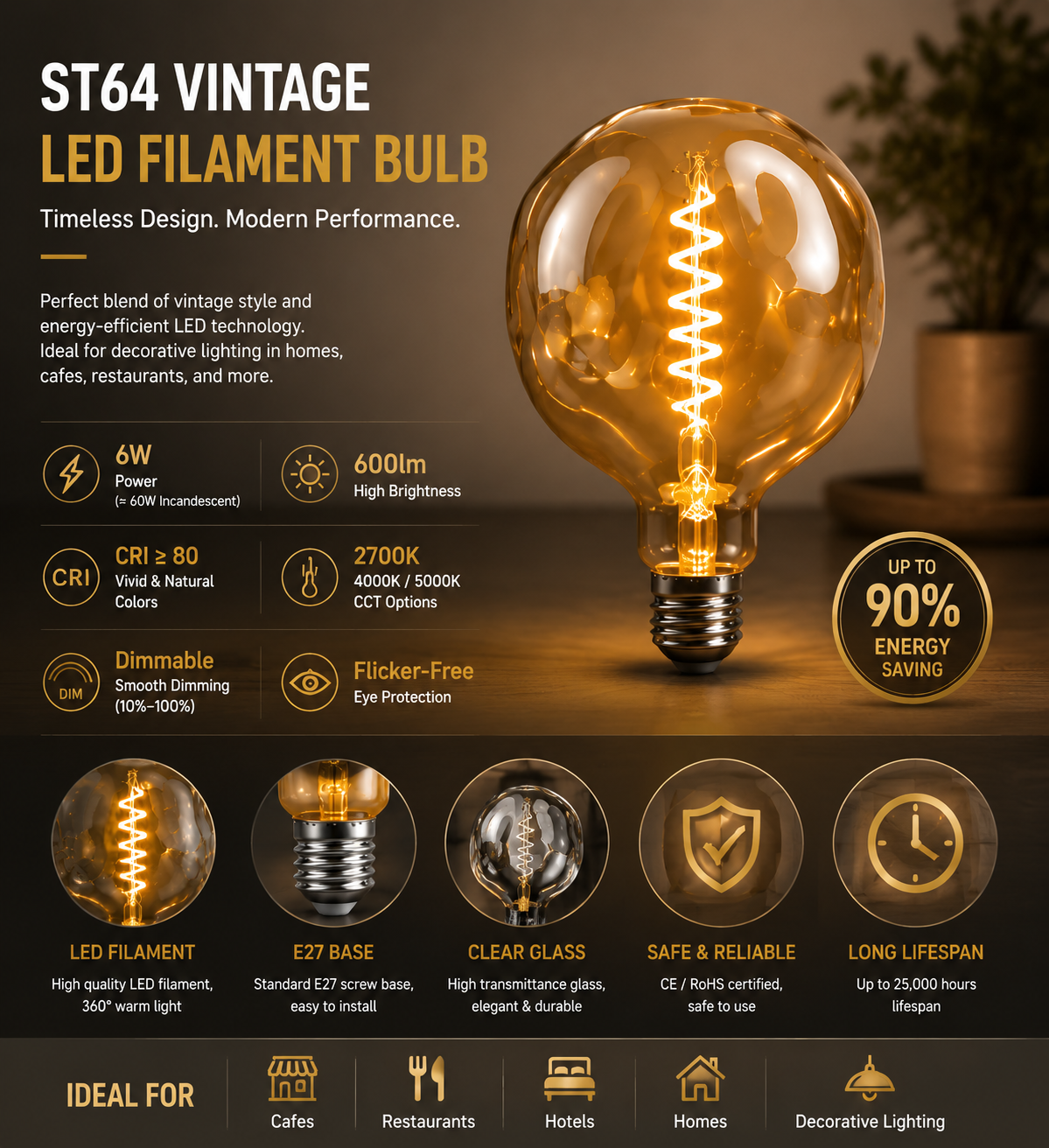
Standard filament bulbs are usually selected for simple on/off use, and in some cases for dimming. Smart filament bulbs are selected when the project needs remote control, adjustable color temperature, or app- or RF-based control depending on the model. TITK offers LED filament bulbs and decorative LED bulbs, so buyers can align product form with the intended application.
Define Requirements Before You Compare Options
A good procurement brief should answer a few basic questions before comparing samples or supplier quotations.
- Where will the bulb be used? Hospitality, residential, retail, or decorative fixtures may call for different control and appearance requirements.
- What kind of control is needed? Simple switching, wall dimming, remote control, or adjustable color temperature all lead to different product choices.
- What voltage is required? Voltage must be confirmed for the individual model. Never assume a low-voltage bulb can be connected directly to mains AC power.
- Which base is required? Depending on the model, TITK products may use E14, E26, E27, or B22 bases.
- What visual effect matters most? Clear, amber tea, smoke grey, frosted, or milky glass may be available depending on the model.
These questions matter because the right answer for one fixture may be wrong for another. A pendant light, chandelier, wall sconce, or table lamp may each place different constraints on bulb dimensions and light appearance.
Compare Smart and Standard Filament Bulbs by Procurement Use Case
The table below is a practical way to compare smart and standard options without overcomplicating the buying process.
| Buying question | Standard LED filament bulb | Smart LED filament bulb |
|---|---|---|
| Control need | Best for basic on/off use and selected dimmable projects | Best for remote control, color adjustment, or connected lighting workflows |
| Specification complexity | Usually simpler to specify | Requires closer review of control method, voltage, and supported modes |
| Installation | Often easier for simple retrofit projects | May require more planning for pairing, control compatibility, or commissioning |
| Project fit | Suitable when the lighting scene does not need frequent changes | Suitable when users need flexibility in light color or control behavior |
| Sourcing risk | Lower risk if the fixture and voltage are straightforward | Higher risk if the control system, app, or remote format is not clearly specified |
For buyers of smart LED bulbs, the question is not whether the product is advanced. It is whether the control method matches the project and whether the supplier can clearly confirm the final configuration.
Identify Sourcing Risks Early
In procurement, many problems start when a buyer assumes that similar-looking products perform the same way. With filament bulbs, the main risks are usually specification drift, incompatible control expectations, and unclear voltage or base requirements.
1. Control compatibility
Smart bulbs may use functions such as remote control, smooth dimming, or adjustable color temperature depending on the model. If the project requires a specific control method, confirm it in writing before ordering. Do not assume one smart product will work with every controller or dimmer.
2. Voltage mismatch
TITK manufactures products for different voltage applications, including AC 110–120V, AC 220–240V, and selected DC low-voltage designs depending on the model. Buyers should confirm the exact voltage on the product level, not just the product family level.
3. Base and fixture fit
Even when two bulbs look similar, the base can differ. Base selection should be checked against the fixture and market requirements. This is especially important for distributors and installers managing multiple regions.
4. Glass and appearance expectations
Decorative buyers often care about visual consistency. Glass finish, filament look, and bulb shape should be approved with samples whenever the project is appearance-sensitive. TITK also supplies product families such as Decorative LED Filament Bulbs, which may be relevant when the decorative effect is part of the buying decision.
Prepare Supplier Questions That Reduce Risk
Before you place an order, ask structured questions. This is one of the most effective ways to separate a general product listing from a model that truly fits your project.
- What is the exact model configuration being quoted?
- What base type is available for this model?
- What voltage version is confirmed for this order?
- Which color temperature options are available for the selected model?
- Is the bulb dimmable, smart-controlled, or both?
- What glass finish is available for this configuration?
- Can you confirm packaging and branding options for OEM or ODM orders?
- Are samples available for approval before bulk purchase?
- What should be confirmed for fixture compatibility before installation?
These questions are especially useful when sourcing dimmable LED bulbs, because dimming performance depends on the exact product and the matching control environment. A buyer should always confirm the final dimming setup rather than relying on product category names alone.
When Smart Bulbs Make More Sense
Smart filament bulbs are usually a better fit when the end user wants flexibility in scenes, brightness control, or color temperature changes. They are also useful when a project needs one bulb type to serve more than one ambience requirement.
TITK’s verified smart configuration includes the ST64 / ST21 2.4G smart LED filament bulb with 2.4GHz RF remote control, smooth dimming, and adjustable color temperature. There is also a verified low-voltage dual-CCT ST64 configuration. These are model-specific examples, so buyers should confirm whether the selected product is a standard mains-voltage bulb or a low-voltage design before ordering.
When Standard Bulbs Are the Better Choice
Standard filament bulbs are often the more practical choice when the project needs a clean, simple specification and the lighting scene will remain stable. They are often easier to stock, easier to explain to end customers, and easier to match to fixed installations.
This is why many distributors still keep a core line of standard LED filament bulbs alongside smart options. A mixed portfolio can serve both simple replacement needs and more advanced decorative lighting projects.
Questions to Confirm with TITK Before Ordering
For buyers working with TITK, the best next step is to confirm the model-specific details that affect ordering and installation.
- Which lamp base is available for the target model?
- What voltage version should be selected for the destination market?
- Which glass finish and color temperature are available for the chosen bulb?
- Is the project using standard, dimmable, or smart control?
- Are OEM or ODM options needed for branding, packaging, or product specification?
For buyers comparing smart vs standard LED filament bulbs, the safest approach is to start with the fixture, the control method, and the market voltage, then request a quotation for the exact configuration. If you are planning a wholesale or project order, LED Bulbs and model-specific product pages can help you narrow the shortlist before you contact the supplier.
Need a practical next step? Request a quotation, ask for samples, and confirm voltage, base, and control function before you approve bulk production.



